
Flatwork for the Three Rivers city
Concrete Contractors in Fort Wayne, IN
Driveways, patios, walks and floors built on a drained base for flat lots, hard freezes and road salt, with every line priced in writing.
- Free on-site measuring and a written, line-item quote
- Leveling or resurfacing priced beside replacement when it will work
- Public walk and drive approach permits checked before the pour
Concrete Built for Flat Ground and Hard Winters
Elite Concrete Contractors Fort Wayne pours new concrete and repairs worn slabs for homeowners in Fort Wayne, Indiana, the Allen County seat where the St. Joseph, St. Marys and Maumee rivers meet. With 263,886 residents at the 2020 census and more than 110 square miles of land, the city holds everything from early-1900s bungalows to subdivisions finished in the last few years. As concrete contractors in Fort Wayne, we see the same two forces behind most failures: water that has nowhere to go on flat ground, and winters that freeze that water again and again.
Why Fort Wayne concrete breaks down
Wikipedia's climate table for Fort Wayne lists an average January high of 32.6 degrees and a low of 18.4, with about 33.6 inches of snow and roughly 39.5 inches of total precipitation a year. That puts the temperature on both sides of freezing for much of the winter.
The landscape adds to it. The same article describes the land as flat, shaped by the Wisconsin glaciation, with the Fort Wayne Moraine following the St. Marys and St. Joseph rivers and the former Great Black Swamp, a lake plain left by Glacial Lake Maumee, lying to the east. On a flat lot, a driveway or patio needs a deliberate slope built in, or rain and meltwater sit against it and soak the ground underneath.
Here is what that does to a slab:
- Surface scaling. Water in the top layer freezes, expands and pops off thin flakes, and salt brine speeds the cycle.
- Heaving and settling. Wet soil under the slab lifts when it freezes and softens when it thaws, so panels crack and drop out of line.
- Trip edges. Walks and aprons that settle unevenly leave lips that catch toes and snow shovels.
Our standard response on every exterior job:
- Air-entrained concrete, which leaves tiny voids that give freezing water room to expand
- A compacted crushed-stone base so water drains away from the underside
- A built-in fall away from the house and garage, since the ground will not provide one
- Thickness set by the load, about 4 inches for foot traffic and more where vehicles park
- Control joints cut on a planned layout, and no rock salt during the first winter
Housing from three eras
Fort Wayne's concrete tells the age of its neighborhoods. Census survey figures for the Fort Wayne Community Schools district (ACS 2019-2023, via NCES) show 51.5 percent of homes built before 1970, 36.0 percent from 1970 to 1999, and 12.6 percent from 2000 on. Wikipedia notes that more than 5,000 homes went up between 1950 and 1955 alone, many in large subdivisions, and that the city annexed about 12.8 square miles of Aboite Township on January 1, 2006, adding 25,094 residents.
That mix means three different kinds of jobs:
- Older central neighborhoods such as the Williams-Woodland Park and Forest Park Boulevard historic districts, where stoops, narrow drives and walks have often settled and been patched more than once.
- Mid-century subdivisions where original driveways and patios are well past the 30 to 40 years HomeGuide gives as a driveway's typical life.
- Newer southwest and north-side homes where the first driveway is now cracking at the apron or settling by the garage door.
The concrete the City shares with you
In front of most Fort Wayne homes, part of the concrete sits in the public right-of-way. The City runs a Barrett Law 50/50 Cost-Share program for residential sidewalks, yard walks, drive approaches and curbs inside city limits. The City's contractor does the work, and the City and owner each pay half. The City's own estimate is about $550 to $600 per 5-by-5-foot sidewalk square, so the owner's share is about $275 to $300. Funding is limited and first come, first served, and petitions filed in summer, fall or winter usually go toward the next year's construction list.
If you would rather hire a contractor for that public concrete, permits come from the Right-of-Way Office: a $15 Sidewalk Permit to reconstruct an existing public walk, and a $50 residential access permit for a driveway approach, followed by a pre-pour inspection of the forms and grade. Our quote shows which part of the job is yours, which part is in the right-of-way, and which route is likely to cost you less.
What we pour and repair
- Driveways: tear-out and replacement, widening, new aprons and parking pads.
- Patios: broom, colored and exposed-aggregate slabs, with paths to the door or the gate.
- Stamped concrete: stone, slate and brick patterns for patios, entries and driveway borders.
- Sidewalks and steps: front walks, yard walks, side paths, stoops and poured stairs.
- Garage floors and slabs: replacement garage floors, plus pads for sheds, equipment and trash bins.
- Repair and leveling: lifting sunken panels, resurfacing sound slabs, sealing cracks and replacing the pieces that are past saving.
A job from first call to cured slab
Measuring visit. We walk the site with you, measure, check how water moves across the lot and note anything that affects the price, such as tree roots, access for the ready-mix truck or an old slab of unknown thickness.
Written quote. Each part of the work is a separate line. If repair is a real option, it is priced next to replacement.
Permits and prep. We confirm the permits your address needs, break out the old surface, remove soft soil, compact the stone base and set forms to grade.
Pour and finish. Reinforcement where the slab needs it, then placing, finishing, texture and joints.
Cure and care. You get dates in writing. HomeGuide's driveway guide says to stay off with cars for at least 7 days, keep heavy vehicles off for the full 30-day cure, and wait 28 to 30 days before the first coat of sealer.
When to schedule
Most outdoor concrete in northeast Indiana goes in between the spring thaw and the first hard freezes of late fall. Concrete that freezes before it gains strength can be ruined, so late-season pours need a mild forecast and sometimes insulated blankets. If the work touches public concrete, remember that the City's cost-share petitions filed late in the year usually roll to the next summer, so it pays to decide early. Call (260) 300-8234 and we will tell you honestly whether this season or next spring gives you the better slab.
Where We Work
Most of our work is inside Fort Wayne, from the older blocks around downtown and the 1950s subdivisions to the Aboite area on the southwest side and the newer neighborhoods to the north. We also work in the Allen County towns around the city: New Haven to the east, Huntertown and Leo-Cedarville to the north, Grabill to the northeast and Roanoke to the southwest. Farther out we cover Auburn, Columbia City, Huntington and Decatur. Rules differ by place. The City of Fort Wayne's 50/50 cost-share and right-of-way permits apply only inside city limits, while the towns and unincorporated Allen County have their own offices, so each town page notes what we found for that community.
- Concrete Contractors in Fort Wayne, IN
- Concrete Contractors in Aboite, IN
- Concrete Contractors in New Haven, IN
- Concrete Contractors in Huntertown, IN
- Concrete Contractors in Leo-Cedarville, IN
- Concrete Contractors in Grabill, IN
- Concrete Contractors in Woodburn, IN
- Concrete Contractors in Monroeville, IN
- Concrete Contractors in Harlan, IN
- Concrete Contractors in Churubusco, IN
- Concrete Contractors in Columbia City, IN
- Concrete Contractors in Auburn, IN
- Concrete Contractors in Garrett, IN
- Concrete Contractors in Waterloo, IN
- Concrete Contractors in Kendallville, IN
- Concrete Contractors in Avilla, IN
- Concrete Contractors in Roanoke, IN
- Concrete Contractors in Huntington, IN
- Concrete Contractors in Markle, IN
- Concrete Contractors in Ossian, IN
- Concrete Contractors in Bluffton, IN
- Concrete Contractors in Decatur, IN
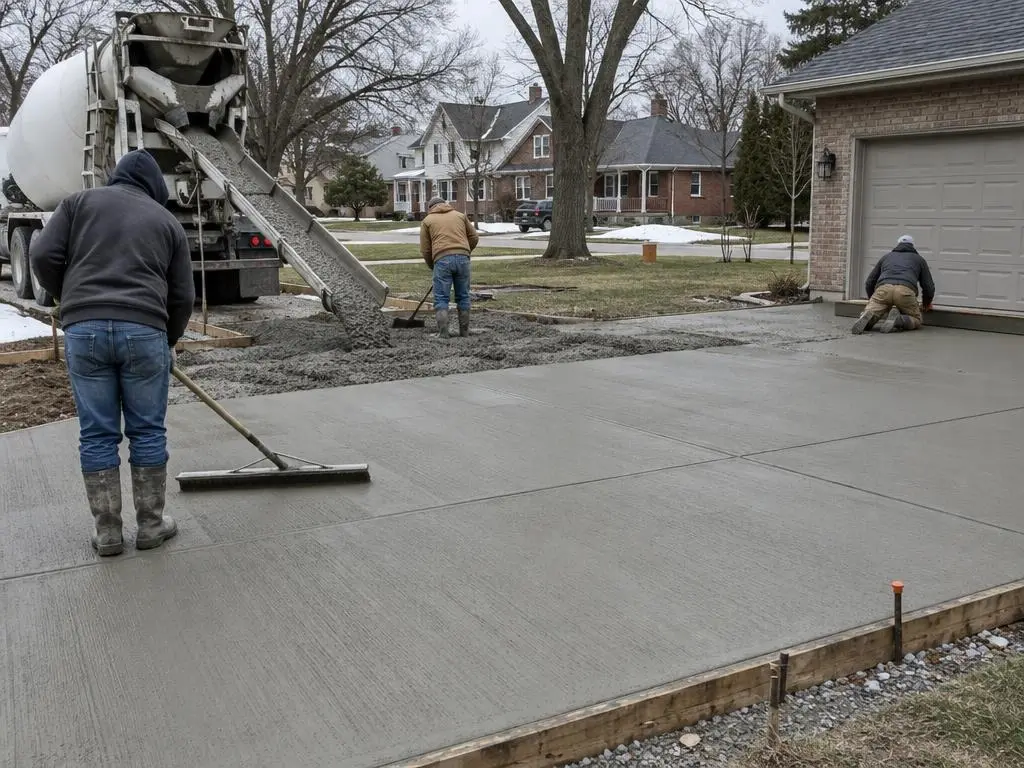
Our Concrete Services
Six kinds of residential concrete work, each planned around Fort Wayne's flat lots and freeze-thaw winters.
Concrete Driveways
Replacement and new driveways on a drained stone base, sloped for flat lots and thick enough for what you park.
Learn more →Concrete Patios
Backyard patios sized for how you use them, sloped away from the house and finished in broom, color or exposed aggregate.
Learn more →Stamped Concrete
Patterned and colored concrete that looks like slate, stone or brick, for patios, entries, walks and driveway borders.
Learn more →Sidewalks & Steps
Front walks, yard walks, side paths, stoops and poured steps, with the City's right-of-way rules sorted out first.
Learn more →Garage Floors & Slabs
Replacement garage floors and new slabs for sheds, workshops, equipment and trash bins, built thick enough for the load.
Learn more →Concrete Repair & Leveling
Lifting sunken slabs, resurfacing worn concrete, sealing cracks and replacing only the panels that are past saving.
Learn more →Common Questions
How do I choose between residential concrete contractors in Fort Wayne?
Get two or three written bids and compare what is inside them, not only the total. Each should state slab thickness, base depth, air-entrained concrete, reinforcement, joint layout and who handles any right-of-way permit. Ask each bidder why your current slab failed; a clear answer is a good sign the new one will not fail the same way.
Should I order ready-mix concrete myself or hire a concrete contractor?
Ready-mix suppliers deliver concrete; they do not dig out the old slab, build the base, set forms or finish the surface. For a small pad, a confident homeowner can manage a short delivery. For a driveway, patio or anything in the public right-of-way, the prep, finishing and permits are where most of the value is, and that is the contractor's job.
Does the City of Fort Wayne help pay for sidewalk repairs?
Inside city limits, the Barrett Law 50/50 Cost-Share program splits the cost of replacing residential sidewalks, yard walks, drive approaches and curbs in the right-of-way. The City estimates about $550 to $600 per 5-by-5-foot sidewalk square, half paid by the owner. The City's contractor does that work; call the Right-of-Way Office at 260-427-6155 to petition.
Do I need a permit to replace my driveway apron?
In Fort Wayne, an access permit is required to build, remodel or relocate a driveway approach onto a public street, and the residential fee is $50. A Right-of-Way Inspector checks the forms and grade before the pour. Work on the private part of the driveway is handled differently, so we confirm what your address needs.
What does a new concrete driveway cost?
HomeGuide's national guide lists standard concrete driveways at $6 to $10 per square foot installed, or $2,400 to $6,000 for a 20-by-20-foot two-car drive. Removing an old driveway adds about $2 to $6 per square foot. Local conditions change the number, so the measured, written quote is the real price.
Why does my concrete flake every spring?
That flaking is called scaling. Water in the top layer freezes and expands, and salt adds more freeze-thaw cycles and keeps the surface wet. Slabs without entrained air, slabs finished while water was on the surface and slabs salted in their first winter are the most likely to scale.
Can a sunken slab be raised instead of replaced?
Often, yes. If the panel is still in one piece, leveling by mudjacking or foam injection can lift it back into line. HomeGuide puts mudjacking at $4 to $9 per square foot and says leveled concrete typically lasts 5 to 10 years or more, so it is best when the slab itself is sound.
When can I drive on new concrete?
Light foot traffic is usually fine after a day or two. HomeGuide recommends keeping cars off for at least 7 days and heavy vehicles off for about 30 days. We give you written dates for your slab based on the mix and the weather that week.
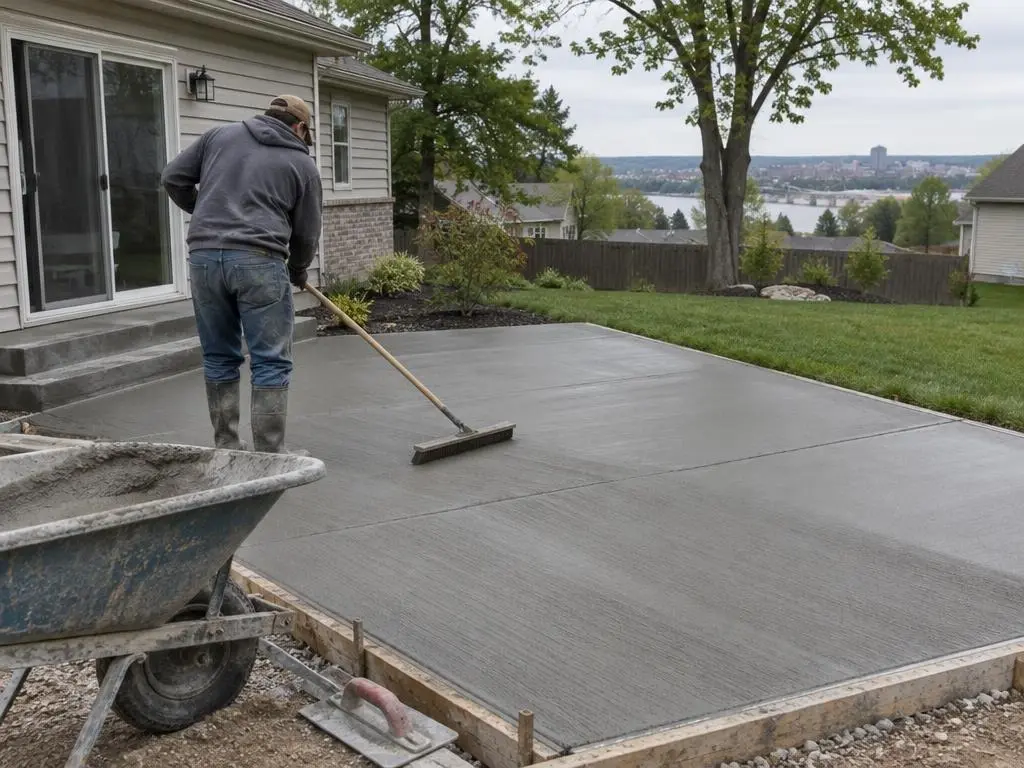
Why Homeowners Call Elite Concrete Contractors Fort Wayne
Drainage planned on flat lots
A compacted stone base and a built-in fall carry water away, because flat Fort Wayne ground will not do it for you.
Itemized written quotes
Tear-out, base, thickness, reinforcement, finish and sealing each priced so bids line up.
Repair priced next to replacement
If leveling or resurfacing will hold, you see that price as well as the cost of new concrete.
City programs explained
We show what sits in the right-of-way and whether the 50/50 cost-share or a contractor permit makes more sense.
Get a Free Concrete Estimate in Fort Wayne
We measure on site and price the work in writing, in Fort Wayne and the surrounding Allen County towns.